For original thinkers
Creative systems
for original thinkers.
You have the expertise. The ideas are there. But the offers, website, visual story and content may no longer fit together. GriffinsEye turns complex thinking into clear offers, compelling visual stories and reusable creative systems — so your ideas become easier to understand, buy and build upon.
The problem
Your expertise has outgrown the way it's organized. AI can accelerate the output. Without a system, it accelerates the confusion too.
Ideas accumulate. Offers evolve. Websites get patched together. New tools create new possibilities. Eventually the business contains plenty of intelligence but no longer has a clear structure for expressing it. GriffinsEye helps you see the whole thing, decide what matters, and build the creative structure around it.
What we do
Ideas rarely arrive as neat products. They arrive as fragments, instincts and questions. We give them form.
Positioning, offer architecture, customer pathways and strategic direction. Help people understand what you do, who it is for and why it matters.
Visual storytelling, websites, editorial assets and sales materials. Turn complex thinking into forms people can quickly see, understand and engage with.
Reusable creative systems, AI workflows, templates and operating tools. Build a structure that allows good thinking and strong creative work to compound rather than constantly starting over.
The GriffinsEye method
- SeeWhat is distinctive in the work, and what is quietly diluting it.
- ShapeThe few decisions that turn scattered material into one clear direction.
- TranslateThat direction made visible: language, image, and offer.
- SystemizeRules that keep every future piece coherent, whoever makes it.
- TransferHanded over, so the work keeps holding its shape without us.
The point is not a pile of assets. It is a way of making that holds.
Who we work with
Experts, educators and founders with real substance and a message that hasn't caught up.
You have the material
Years of expertise, a body of work, often a great deal of content. What's missing is not supply.
It doesn't add up yet
Every piece is good on its own. Together they read as several businesses instead of one.
You can feel the difference
You know coherent from chaotic when you see it, and you'd rather have discipline than another deliverable.
Ways to work together
Three ways in, from a single hour to a full rebuild.
A strong idea and a muddy message, taken apart and put back together. A clearer offer, a sharper way to say it, a decided next move.
$197 → Scoped engagement Creative Systems BuildGriffinsEye's primary implementation engagement — positioning, visual identity, website and the reusable systems that hold it together, scoped to what your business actually needs.
From $3,500 → Founding round · five places The Offer Field TestOne idea put in front of real people with a real ask, in a bounded window — and read without flattery.
$500 →How we use AI
AI multiplies your thinking. It doesn't replace it.
GriffinsEye isn't selling AI automation. AI shows up here as creative leverage — a force multiplier for reusable systems, workflows, and the thinking you've already done — with human judgment and discernment always making the final call.
Start a project
Bring the idea as it actually arrived.
You do not need a brief. Start with the idea, the problem, or the collection of open tabs you're trying to make sense of.
Write to GriffinsEye →An offer from GriffinsEye
Don't debate the idea forever. Put it in the field.
For founders, consultants, creators and experts with a promising idea that needs evidence before it needs more investment. One idea. One test. One clear next move.
One idea, taken all the way to a decision.
Five deliverables you keep.
You bring The idea, and people you can genuinely reach.





Is it for you
The idea is clear enough to say out loud. What you don't have is proof.
It fits
You know roughly what the offer is, you've talked about it for months, and another round of thinking has stopped producing anything new.
It doesn't
If the idea still changes shape every time you describe it, test that first — the Creative Clarity Review is built for exactly that.
Not sure yet
Run The Demand Ledger first. It's free, takes twenty minutes, and counts the evidence you already have.
How it runs
- BeginIntakeOne conversation about the idea as it actually arrived. No brief required.
- BuildHypothesis & storyWe shape the offer and give it a visual form you can put in front of people.
- Ten business daysThe windowA real ask goes to a small, specific audience. Nothing gets changed mid-test.
- CloseThe next moveThe signals, read without flattery, and one recommendation.
Clarity doesn't always come before action. Sometimes action produces clarity.
What you keep
-
01
Deliverable oneOffer Hypothesis
An idea becomes testable when it becomes an offer: who it is for, what they get, what it costs them, and which assumptions have to hold. We name those assumptions so the test can touch them.
The offer, stated once, clearly.
-
02
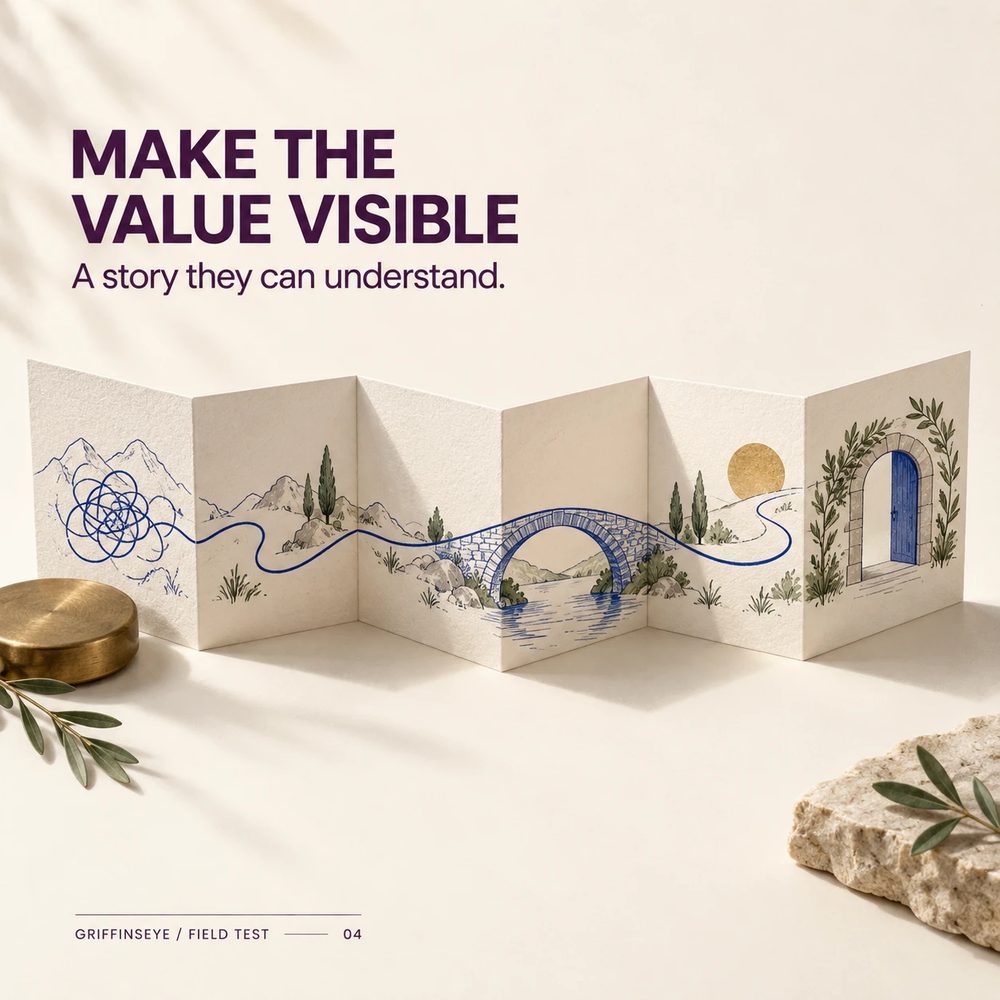
Deliverable twoVisual Sales Story
People respond to what they can see. The offer is given a compact visual form — the proposition, the shift it makes, the invitation — built to be put in front of someone, not admired in a folder.
The idea, made visible.
-
03
Deliverable threeMarket Test
A designed experiment with a real ask — a deposit, a pre-order, a booked call, a waitlist that costs something to join — sent to a small, specific audience inside the window, so the result means something.
A real ask, in a bounded window.
-
04
Deliverable fourField Intelligence
What people did, not what they said they would do. Who leaned in, who hesitated, where the language landed and where it slid off — resolved to one of five readings.
ProceedRefineRepositionInvestigatePivot -
05
Deliverable fiveNext-Move Brief
One recommendation, the reasoning behind it, and what it would take. Whichever reading the field returned, you leave knowing what to do next — and what not to build.
One decision, and why it's that one.
What you bring
We build the test. You make the ask.
- The idea
As it actually arrived. Fragments are fine; that is what the intake is for.
- People you can reach
A small, specific group you could write to by name. The test is only as meaningful as the people who see it.
- Ten business days
A willingness to put a real offer in front of those people inside the window — and to leave it alone while it runs.
Founding round
Five ideas. One field.
The founding round runs the Offer Field Test with five clients at a founding price. In return, the method gets sharpened on real ideas — and you get evidence before you spend another season thinking.
- Offer Hypothesis
- Visual Sales Story
- Market Test
- Field Intelligence
- Next-Move Brief
One payment. You'll receive the intake questions by email within one business day.
A three-week engagement
The Creative Operating System.
Three weeks, working together, to decide your visual language once and leave you with the framework that reproduces it. Not a logo and not a content service — the rules that make everything you create afterwards look like it came from the same place.
Two live sessions with me.
Five things you keep and reuse.
You bring Work you have already made, and one person who can decide.
Why this exists
Anyone can generate. The hard part is making it cohere. Volume without a system is noise.
What happens now
Every piece gets made from scratch. Each one is fine on its own. Together they read as several different businesses, and the inconsistency is doing quiet damage.
What usually gets tried
More tools, another template pack, a fresh round of prompts. More supply, aimed at a problem that was never short of supply.
What actually fixes it
Deciding the visual language once, writing it down as rules specific enough to reproduce, and making everything from those. The system does the remembering.
How the three weeks run
-
1
Week oneIntake and direction
You send what you have already made — the good, the abandoned, the things you keep reaching for. I read it for what is genuinely distinctive and what is quietly diluting it. Then we spend ninety minutes together deciding the direction: what to keep, what to cut, and what makes the work unmistakably yours.
You leave week one with the direction, decided.
-
2
Week twoThe system, built
I turn that direction into a specification: the constants that never move, the variables you are free to change, and the grammar that holds them together — colour, type, material, light, composition. Alongside it I build the image art direction framework, then generate real examples and correct them against the spec until the output is reliably yours rather than occasionally yours.
You leave week two with a written system and proof it works.
-
3
Week threeMade repeatable
We apply the storyboard method to one real sequence of yours, so you have run the whole path once with me watching. What worked gets saved as reusable instructions you own. We close with a sixty-minute handover: how to run it, where it will drift, and what to do when it does.
You leave week three able to run it without me.
The point is not a pile of assets. It is a way of making that holds.
What you keepFive
durable
things
Yours afterwards, with or without me.
Every one of these is written down and reusable. Nothing here depends on remembering a conversation, and nothing expires when the engagement ends.
- 01Creative Direction Read
An honest read of the work you already have: what is distinctive, what is diluting it, and the few decisions that would make it cohere.
- 02Visual Language Specification
Your constants, your variables, and the grammar between them — specific enough that something made next year still belongs.
- 03Image Art Direction Framework
The repeatable brief behind your images: ground, light, subject, type and finish, written as parameters rather than adjectives, with worked examples.
- 04Storyboard Method
How to sequence before you make, applied once to a real piece of your work so you have done it rather than read about it.
- 05Reusable Skill Pack
The instructions that produced the good results, saved so the next run starts where this one finished instead of from scratch.
The part most people are missing
An image framework written as parameters, not as adjectives.
“Warm and editorial” produces something different every time you ask. A framework names the ground, the light, the subject, the type treatment and the finish — so the same brief produces the same world, whoever runs it and whatever tool they run it in.
Reproducible
The same brief gives you the same world next month, not a near miss.
Transferable
It works when someone else runs it, which is what makes it a system rather than a talent.
Tool-agnostic
Written as direction, so it survives whichever model or tool you are using next year.
Honest boundaries
What you bring, and what this is not.
- Work to look at
Whatever exists already. Rough and inconsistent is useful — that is the material.
- One person who can decide
The engagement turns on choices being made. A committee will stretch three weeks into three months.
- About two hours, live
Ninety minutes in week one, sixty in week three. The rest is my work, not your meetings.
Not a logo project
If what you need is an identity designed from nothing, this is the wrong engagement.
Not content production
I build the system and prove it works. Ongoing output is yours to run, or a separate conversation.
Not software
Nothing to subscribe to. The framework is documentation you own.
Start it
Decide it once. Make everything from it.
If you are already producing a lot and it keeps coming out slightly different, the problem is not effort. It is that nothing is holding the decisions. Three weeks, and something is.
- Creative Direction Read
- Visual Language Specification
- Image Art Direction Framework
- Storyboard Method
- Reusable Skill Pack
One payment. You will get the intake questions by email within one business day, and we book the first session inside week one.
The Creative Clarity Review
You don't need more ideas. You need clarity.
with Tara Griffin
A focused sixty-minute session for people with a strong idea and a muddy message. You bring the tangle. You leave with a clearer offer, a sharper way to say it, and the next move already decided.
Is this you?
Are you someone who…
- can explain the idea perfectly out loud, then watches it go flat on the page?
- has rewritten the about page more than once and still hasn't shipped it?
- describes the offer a little differently every time someone asks?
- has people who admire the work but can't tell anyone what you do?
- keeps reaching for another idea, another rebrand, another course?
- suspects the problem is one decision you haven't made yet?
Why this exists
That gap is not a writing problem.
The idea isn't unclear. It's undecided. Until one version is chosen and said out loud to someone, every version stays equally possible, and equally unsayable.
Muddy messages are almost never muddy everywhere. There's usually one unresolved decision: who it's really for, what it replaces, what you won't give up. Everything downstream stays vague to protect it.
How the hour runs
Four movements, one hour.
Sixty minutes, live, one to one. Nothing to prepare.
- iMovement one
You talk
You describe the idea the way you'd describe it to a friend: fragments, tangents, the version you keep abandoning halfway. I listen for the sentence you keep circling back to.
What surfaces: the thing you actually mean.
- iiMovement two
We find the knot
Muddy messages usually hide one unresolved decision. We find the one everything else is protecting.
What surfaces: the decision you've been working around.
- iiiMovement three
We name it
Words for the offer, who it serves and what makes it different, said aloud and adjusted until it sounds like you and not like marketing.
What surfaces: language you can use on Monday.
- ivMovement four
We map the next move
One move, chosen because it produces the most information for the least effort. Not a list of twelve things you'll feel guilty about by Thursday.
What surfaces: one thing to do, and why it's that one.
What you get
What you walk away with
A clearer offer
What you're actually selling, who it's for, and why it's worth what you're asking, in words you can say out loud without hedging.
A stronger message
Language specific enough to be believed, short enough to be repeated, and recognisably yours rather than borrowed.
Smarter next steps
One clear next move and the reasoning behind it, so you know why it matters more than the other eleven things.
Most of the fog turns out to be one unmade decision wearing a disguise.
Tara Griffin · GriffinsEye

Your host
Who you'll be talking to
Tara Griffin founded GriffinsEye, a creative systems studio for original thinkers whose expertise has outgrown the way it's organized and expressed. In the hour she listens for the sentence you keep circling back to, then helps you decide what it means.
Before you book
Bring it messy.
The hour is built for the version you haven't figured out yet.
- Nothing to prepare. No deck, no brief, no homework.
- One idea, taken all the way, rather than a quick tour of everything.
- You leave with one next move, not a list to feel guilty about.
- Nobody hands you an idea. The words that come out of the hour are yours.
Book it
One hour. One decision.
Bring the version you keep abandoning halfway. That's usually the one worth finishing.
- Length
- Sixty minutes
- Format
- Live, one to one with Tara
- Scheduling
- After payment, I'll follow up by email to find a time that works.
- You leave with
- A clearer offer
- A stronger message
- Smarter next steps
- A decision, not a maybe
One payment, one session.
Questions
Before you book
Do I need to prepare anything?
No. No deck, no brief. Come with the idea as it is right now, including the parts you keep abandoning.
What if I have more than one idea?
The hour takes one idea all the way. If you can't choose, pick the one you keep coming back to. That's usually the one.
How do we find a time?
After you pay, I'll follow up by email to set a time that works for you.
What if I want someone to hand me an idea?
Then this isn't the right session. The hour works with the idea you already have.
What if the idea is already clear?
Then what you need is evidence, not clarity. Go straight to the Offer Field Test.
Where it leads
Clarity first. Then evidence.
About
Beautiful structure for consequential ideas.
GriffinsEye is a creative systems studio founded by Tara Griffin for original thinkers whose expertise has outgrown the way it is currently organized and expressed. The studio combines strategic clarity, visual storytelling, systems thinking and emerging creative technology to turn complex ideas into things people can understand, use and act on.
Founder Tara Griffin, Founder and Creative Director. Working between coastal Maine and Guanacaste, Costa Rica.
More about Tara →
Contact
What are you trying to make clear?
You don't need a perfect brief. Bring the idea, the problem, the half-built offer or the collection of open tabs. We'll find the thread.
Free: The Demand Ledger
$197: Creative Clarity Review
$500: The Offer Field Test